PreMatch
A football prediction app that invites reflection
For my master's thesis at MCI Innsbruck, I designed and built PreMatch: an app where friends predict football results in private leagues. The market has two extremes. Kicktipp keeps its users mainly because their friends are already there. Betting apps like Tipico often use patterns that encourage fast betting.
PreMatch sits in between. It takes motivation seriously without exploiting it. At its core is “Positive Friction”: you save a prediction by holding the button, then the app briefly asks for your reason.
- Type
- UX/UI · App design · Master's thesis
- Role
- Research, UX/UI design and development
- Timeline
- 2026
- Tools
- Figma · Flutter · Firebase · API-Sports
Key figures
- Usability (SUS, out of 100)
- 90.0
- Source: User study of the thesis, N = 10, 2026
- Recommendation (NPS), no detractors
- 70
- Source: User study of the thesis, N = 10, 2026
- Identity (AttrakDiff HQ-I, −3 to 3)
- 2.03
- Source: User study of the thesis, N = 10, 2026
Starting point
Social football prediction apps are a neglected corner of sports technology. Kicktipp leads the German-speaking market mainly thanks to network effects. Commercial betting apps invest heavily in design, but often with dark nudges that suppress reflection and exploit impulsive behaviour.
The research question: how can principles of Self-Determination Theory (autonomy, competence, relatedness) and Positive Friction be built into a prediction app so that the experience exceeds the current market standard? The method was Design Science Research in three phases.
Phase I: Benchmarking
I compared four apps: Kicktipp, Tackle, Teamtip and Tipico. The basis was the Gameful Design Heuristics with 28 motivational dimensions, rated on a scale from 1 to 5 and cross-checked by a second coder.
The whole market scored lowest on Social & Community (mean 2.10) and Immersion & Narrative (2.25). That is not a critique of one app but a description of what the market has not built yet. Exactly these gaps became the priority list for the design.
Phase II: Design and build
The key design decisions trace back to a gap from the benchmark. The path led from paper sketches to a Figma prototype to a working Flutter app.
Sketches
The first drafts were deliberately made on paper, so the focus stayed on structure and order of content, not colour. The Home screen shows your standing, the live match with your prediction and the league table. My Tips is the list of a matchday’s fixtures where you enter your predictions.
Design system
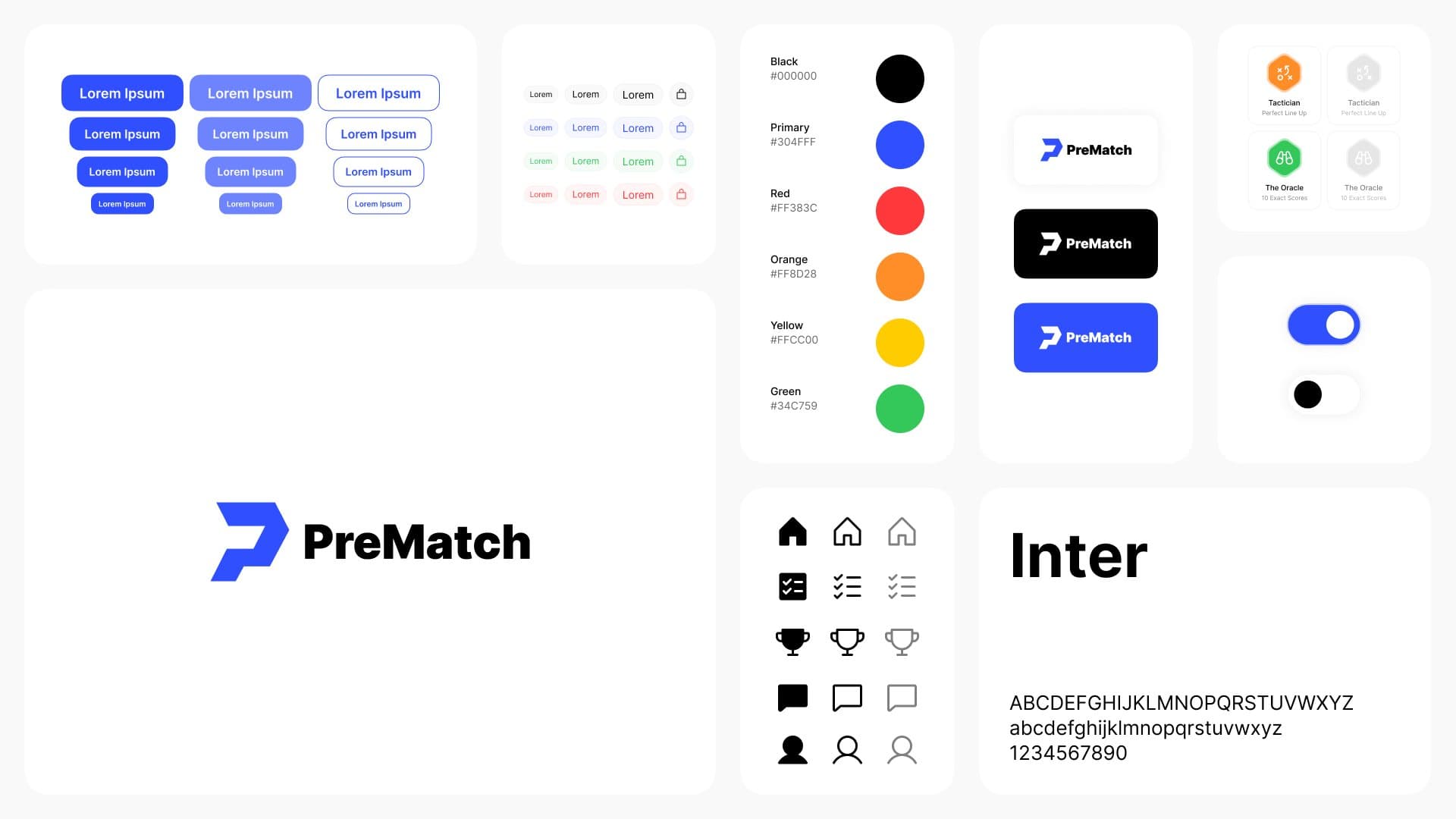
The design system is built on a strong blue (#304FFF), the Inter typeface and colours with clear meaning: green for right, red for wrong. Icons come in three states. Badges such as Tactician for a perfect line-up or The Oracle for ten exact scores reward skill rather than just logging in. Club crests and tables aim to carry the feel of a real matchday.
Positive Friction
The key decision: a prediction is not saved with a tap but by holding the button. Then “Why this pick?” appears with reasons such as home advantage, form or gut feeling. It is optional and shows your league how you think. This creates a short moment of reflection instead of an impulsive prediction.
Technically, the app is built in Flutter. Match data comes from API-Sports; sign-in, leagues, predictions, chat and badges run on Firebase. Leaderboard and chat update live.
Phase III: User study
Ten people tested the app between 16 May and 7 June 2026, with questionnaires (SUS, AttrakDiff, INTUI, NPS) and a debrief interview.
Usability reached a SUS of 90.0, in the excellent range. AttrakDiff showed a profile driven mainly by joy and identity (HQ-I 2.03), which suggests participants identified with the app. All four INTUI scales were above the midpoint, with gut feeling highest (5.30 on a scale of 1 to 7). The NPS was 70 with no detractors. Together, the results tentatively support the idea that Positive Friction can lift the experience without hurting usability or intuitiveness.
Limits and outlook
With ten participants, the results are indications, not proof. There was no comparison version without friction, and the study only captures first use. Whether holding to save keeps its effect over a whole season remains open. Club crests would need licences for a public release.
The biggest practical question: will a whole friend group move to a new app along with its league history? Next steps could be a field study across a full season and friction that adapts to how someone tips. The pattern of holding and a short reason also transfers to other areas where impulsive behaviour has real costs.
Related service: UX/UI Design